Sunday, 26 August 2012

19-21/3/2012 - No peace in La Paz – on to Paraguay

I'd had enough Wild Rover-ing so I moved to a more chilled out hostel and spent a few days exploring La Paz (and catching up on much needed sleep).
When I'd been in Cuzco, I'd gotten a recommendation for an Asian food place from the Australian owner of the restaurant at which I'd enjoyed an excellent plate of alpaca.
He could only vaguely remember the area the restaurant was in and didn't even know what it was called but I was up for a challenge and if “the best Asian food In South America” (according to him) was on offer, I was gonna hunt this place down. The midday heat wasn't particularly forgiving as I wandered the streets only having a vague notion of what I was looking for but eventually I tracked it down and boy was it worth the wait.

On Wednesday morning I decided to take in a spot of paragliding which I found to be a somewhat underwhelming experience. Since I'd never done it before, I had to do a tandem flight with a trained instructor. I felt like a giant baby strapped in front of the pilot who did all the steering. After a fun take off where we had to charge down a steep hill side and get the wind to lift us, the flight quickly became tame and dull. Oh well, at least that's that box ticked.
At least the view was nice
Right after getting back, I jumped on a night bus east to Santa Cruz where I spent a grand total of about half an hour before catching a taxi to the airport from which I got a flight to Asunción in Paraguay. I justified this opulence by reasoning that I had very little time left and the money spent (around £100) was worth it. Man oh man why did I waste so much time in Arequipa?

14-18/3/2012 - Uyuni salt flats and another farewell

In the evening we caught a bus bound for Uyuni for our 3 day tour of the nearby desert and the salt flats. We'd been warned about the bus ride to Uyuni being rough and extremely dangerous. Interestingly I slept far better on our 12 hour journey than during either of the nights we'd spent at Wild Rover.
Upon arrival in Uyuni we were joined by an English couple, switched to a 4x4 and hit the dusty road heading in the direction of the triple border point between Bolivia, Chile and Argentina. The terrain quickly became scenically bizarre and Francis' comparison to Tataooine (a planet in one of the later star wars films) was very apt.


Rolling sand dunes surrounded by sand coloured rock outcrops would fall away to reveal valleys of what one would imagine the surface of Mars to look like. Our 4x4 seemed to follow no visible path except tire tracks left by other Jeeps in the sandy landscape. Unfortunately a huge portion of the day was spent inside the Jeep with occasional stops to take photos, but being in a Jeep with 3 raucous Aussies made the time fly. Our last stop, not too far from our nights' lodgings, was a green lake filled with flamingoes. Pretty nice, especially with the snow capped mountains in the background completing the picture.


Setting off in fairly chilly conditions at 5am the next morning we immediately came across some geysers spitting out jets of god knows what which looked all the more imposing as the sun rose and slowly illuminated the bleak landscape around us.
Shortly, we arrived at our breakfast stop which was located right next to some hot springs. Without much hesitation me and Grace took the plunge and it was the nearest thing I'd had to a hot bath in 5 months. Bliss. 


Refreshed and sated we continued our journey eventually making it to the triple border which was situated on a scenic lake-mountain combo. Cue photo and hilarious border hopping around. The rest of the day was spent retracing our steps but the time went by quickly and I got a comprehensive education in Australian music courtesy of my travelling companions. Arriving back in Uyuni we were cooked dinner in our hostel by the lovely woman who was in charge of the tour. A power cut spiced things up but all in all it was an excellent night.


Our final day of the tour saw us joined by 2 sour Australians who were hating on Bolivia and everything else around them (perhaps understandably since they'd lost all of their travel documents and credit cards). Regardless, the rest of us were in high spirits at the prospect of finally getting to see the ethereal salt flats and have a stab at taking some of those tacky perspective shots that everyone visiting the area is obliged to do. However before we got our dessert we had to enjoy our main course which came in the form of the only actual attraction inside the town of Uyuni – a train graveyard! Groan.

Although initially unenthusiastic (Grace actually lives near to a train graveyard back home) we actually had quite a lot of fun climbing around the wrecks and the thrill of potential tetanus from the rusty jagged edges all over the shop made for added danger points.
Leaving with our joints still mobile, we joined the caravan of 4x4's filled with tourists heading to the salt flats.

The shift in landscape was remarkable in its suddenness. Without warning, the dusty road gave way to a vast desolate white plain spreading out ahead of is in all directions as far as the eye could see. The landscape isn't dissimilar to how I envisage an ice desert to be and maybe this is the closest I'll ever get to one. We spent a couple of hours messing around and taking photos. What I should have realised is that everyone else at the salt flats would be doing exactly the same thing and half the fun was watching the hilariously bad attempts of everyone else. Ours tended to involve mostly removal of clothes and terrifying multicoloured balaclava/face masks we'd bought in La Paz.
Francis: "This has nothing to do with perspective, why are we doing this!?" Good question.

Much more civilized
Having had our fill of photo taking and with the sunburn kicking in due to the reflection off the salt, we headed back after a touristy but undeniably fun experience.

Back in Uyuni we grabbed dinner in a tacky tourist dive and got chatting to some other travellers. I had one of the most infuriating conversations of my life with a Swedish guy. Few things in life annoy me but something about this really rubbed me up the wrong way. Without going into detail, it basically comes down to labelling hallucinogenic drug taking as a form of therapy. This guy wasn't the first person I'd met refer to taking Ayahuasca and San Pedro (types of naturally extracted hallucinogenic substances) as “work” or to the drugs themselves as “medicine” but he was the first I'd had any prolonged conversation with. I wish I hadn't. What I guess gets to me is how people like him try and disguise a recreational and above all FUN activity with serious work and spiritual enlightenment. No, you're not working through your inner problems. You're tripping out and seeing rainbows spiralling out of your hand. It's not hard work. It's fun.
I questioned him on his beliefs and despite his claims that he used to be rational and non-spiritual (“just like you” he said as he looked at me earnestly) his views were wishy washy and inconsistent beyond belief. I really want to meet someone who can actually convey a structured argument or have a bash at having some consistent beliefs but so far my travels have failed to yield fruit. Talking to hippies is probably a non-starter in that respect. Rant over.
Me and Grace got on the bumpy bus back to La Paz but not before saying goodbye to Francis and Scarlett who were heading south to Argentina.

We arrived in the Wild Rover on the Sunday after St Patrick's Day and the place was a picture of tranquillity due to the festivities last night. We spent a day stocking up on more gifts for the folks at home and eating ludicrously cheap restaurant food.

Grace was heading back to Australia in the morning so we had a few drinks in the hostel (the bar being full again in the evening despite nearly everyone we talked to complaining of a horrible hang-over) before ending up at the Hard Rock Café of all places which was inexplicably rammed to the hilt with locals dancing the night away. I said my goodbyes to Grace and vowed, not for the first time this trip, to visit Australia in the near future. Most of the Australians I've met have made excellent travelling companions.

13/3/2012 - Death Road

Staying at the Wild Rover hostel is mostly a chore if you want to do anything other than party. And by party I just mean drink a lot, try and cop off with another traveller then drink more. Sigh. The night before we were due to do the bike ride down Death Road I didn't manage to get a wink of sleep not least because some idiot sat near out dorm and drunkenly attempted to play Arctic Monkey's covers on an out of tune guitar using his out of tune voice at 2am. To add insult to injury, as I started drifting off around 4am he, having failed to get lucky, returned to continue the concert in an even worse state.

We all looked a little sleep deprived as we woke the next morning. As we waited around the hostel reception at 8am, I was startled by a gruff voice behind me. “Phil!? Death Road!” barked a man gleefully looking at our sleepy-eyed crew. Show time.

Views from the start of the ride


The lovely tarmaced road we started on

After a van ride which saw us climb out of La Paz to a height of 4700 metres and kitting up (and our guides reminding us many times that it wasn't a race.. yeah right) we were off!

The first hour's ride was along sweeping nicely tarmacked roads with spectacular views. Although it was initially fun, I had no idea why anyone would call this Death Road. That is, until we got to the seconds part of the ride. Tarmac gave way to loose rock and gravel, wide gentle curves became fiendishly steep hairpin bends and a pleasant ride was transformed into a hair raising experience.
With gay abandon we bombed downhill after our guide, the ride seeming to become easier the faster you went and the more control you relinquished to the gravelly gods.
It definitely wasn’t for everyone and more than a few times we passed other cyclists taking tumbles and moaning bitterly about how much they hated it.
As we left the tarmac behind the road began to live up to it's name

We raced under mini waterfalls and rode through a couple of small rivers, all the while plummeting further down the road which now clung to the imposing cliff face like a caterpillar to a tree trunk.

Although the ride lasted several hours, the injection of adrenaline into the bloodstream was constant and I gave no thought to the fact that I'd hardly slept the previous night. Finally arriving at the end of the road where we procured much needed showers and food, I felt absolutely drained.


A free tacky t-shirt and a CD of photos later, we were back in the hostel and, since this would be our last night in La Paz together, we had a night out in the city which, despite being gringo-heavy was good fun.

The next day we spent wandering La Paz and picking up cheap gifts for folks back home. On several streets the market stalls spilled out on to the pavements in true south American style, but to my dismay the locals weren’t quite as up for haggling as they had been in Peru. Fortunately Bolivia is ridiculously cheap (owing to it being the poorest country in South America) so on several occasions it felt almost rude to try and get even more of a discount.

12/3/2012 - Heading to La Paz

I left behind the stunning scenery and lukewarm showers on Isle del Sol, retraced my steps back to Copacabana (meeting the Aussies en route) and, after a “Bolivian breakfast” at a local eatery (which was basically steak and chips), jumped on a bus to La Paz. Memorably, half way through the journey we arrived at a river crossing, had to disembark and board a smaller boat to cross the river whilst the bus went over on a different barge. At first we wondered why we didn't just stay on the bus, but seeing how the boat it was on lurched in the waves it became clear why this system was in place.

Arriving into La Paz was quite an experience. Our coach wound its way through what seemed to be twisting back alleys sloping demonically downwards into the melting pot of the valley in which La Paz sits. Much like the Vegemite that my Aussie friends made me try, La Paz seemed to polarise opinions. In both instances, I was charmed straight away.

We booked into the Irish themed “Wild Rover” hostel which was fairly middle of the road but did boast hot showers and a lot of travellers who seemed to be desperate to do nothing but party and enjoy gloriously superficial interactions with Bolivian culture. Mini-rant over.

The “must-do” things that everyone I'd met coming from Bolivia had mentioned were the mountain bike ride down “Death Road” - http://en.wikipedia.org/wiki/Yungas_Road and the starkly bleak landscapes of the Uyuni slat flats. My Aussie companions were eager to cram in both as quickly as possible and I jumped aboard.

11/3/2012 - Getting burnt on Isle del Sol

I'd allowed myself plenty of time to get ready for my 8am boat to Isle del Sol so I was somewhat surprised when the hostel owner, with whom I'd booked the trip, burst into my room at half past seven and asked me where the hell I was. Oh yeah... the hour time difference between Bolivia and Peru.


Boarding the boat among the scathing looks of fellow passengers who'd been waiting a good half an hour, I perched myself next to the captain and we set off for our destination. Our journey saw us hug the coast and retrace much of the journey I had done yesterday and I had a good natter with the captain about the various villages we spotted en route.
Finally arriving at Isle del Sol around 10 am we disembarked and I was in an exploratory mood. As I followed the path to the north of the island I was confronted by a man insisting I had to buy a 10 Boliviano (£1) ticket to progress. I was struck by an inexplicable determination to not pay this minuscule amount, complained bitterly to the guy about the injustice of having to pay just to walk along a path and asked him if there was any way in which I could avoid this trail. He pointed to the steep rocky incline to the left of the path and said “Straight up... but you'll bump into more ticket checkpoints later”. I decided to take my chances and started the ascent.

Isle del Sol is gorgeous. As I reached the summit of the hill it turned out I was climbing, I was struck by just how idyllic the setting was. Floating in the middle of the spookily still Lake Titikaka the island felt like a forgotten world of hills and pastures, hardly touched by humans. I barely noticed the Inca ruins on the island – the natural beauty trumped any attempt by the Inca culture to steal the show. I turned off the main track and headed for the west coast of the island, walking for several hours without seeing another soul until, atop one of the hills, I bumped into a sheep herder who lived on the island. As we paused at the summit and chatted about where else I could explore while I was here, he pointed out 2 playful eagles, swooping and diving majestically in the valley below us. This place was ridiculous.


The sun beat down heavily as I topped the highest summit on the island (which thankfully wasn't high) and caught a glimpse of Peru on the distant shore. Eventually I made my way back onto the beaten track. As promised, I did bump into a couple of ticket checkpoints, but they were negotiated surprisingly easily by asserting that I had already bought a ticket and walking briskly away as the weary ticket inspector called after me to produce it. There were several communities living on the island and the majority now made their money from tourism as opposed to traditional methods. I made it to the village of Yumani a few hours before sundown and found lodgings in a half finished hostel which nonetheless had comfortable beds and awesome views over a scenic bay. I'd been walking for over 6 hours so it was with weary feet that I headed along the village's main street in search of food. Stumbling into one of the many touristy looking establishments I was confronted by 3 Aussies, twins Francis and Scarlett and their friend Grace, who were following a similar path to me. Once we'd ordered and were sat chatting, it became apparent that the owner of the place had to either ring up the chef to come cook for us or obtain food from a different establishment. Either way, the food was very welcome and the bottle of cheap wine I shared with the Aussies went down a treat. Little did I know these guys would be part of my life for the foreseeable future.

10/3/2012 - Into Bolivia, Copacabana

An hour from the border crossing into Bolivia, our bus was greeted with a line of cheerful but determined middle-aged Peruvian women blocking the road. I learned later that the protest was about land disputes – apparently the Peruvians want Copacabana to be part of Peru and are thus trying to block the border to stop supplies arriving into land-locked Bolivia.
Standard day on the Peru-Bolivia border

 Somehow our bus managed to skirt the first blockade but 10 minutes before the border we were confronted with another and this time the women really weren't going to budge, so we had to walk it.

In my experience, South America seems to be a place where you have to do your research and be clued up before doing anything that involves money. A lot of travellers I had met got angry and annoyed about the constant attempts of many locals to try and rip you off but I saw it as good fun and a bit of a challenge. This is why I couldn't help but giggle when a woman tried to give me a pitiful exchange rate at an “official” money exchange kiosk. I turned to the guy in the kiosk literally next to her and after some gesticulating got a decent rate from him. Do I feel sorry for the hundreds of people she rips off everyday? NO! Do your research people.

The border crossing itself went smoothly and before I knew it I was in a mini bus bound for Copacabana, a small Bolivian harbour town which sits on the shore of Lake Titikaka.
After finding a room in a hostel overlooking the harbour, I booked myself on a boat for Isle del Sol (an island in the middle of the lake) tomorrow morning, and thus had the rest of the day to kill in Copacabana. “If you want to come back to the hostel after 11pm I will show you how to use the gate” said the kid who'd checked me into the hostel and can't have been older than 17.
“No, it's ok, unless there's a good place to go partying in Copacabana?” I asked.
He smiled a sad smile, looked down and shook his head. It must suck to be a teenager here.

I hadn't had any fresh fish since those lazy days on the Colombian coast so when the lakeside shacks beckoned me in for a lunch of freshly caught trout, I duly obliged. The double-carbs made a reappearance (rice and chips this time) but I steered clear and the fish itself was excellent.

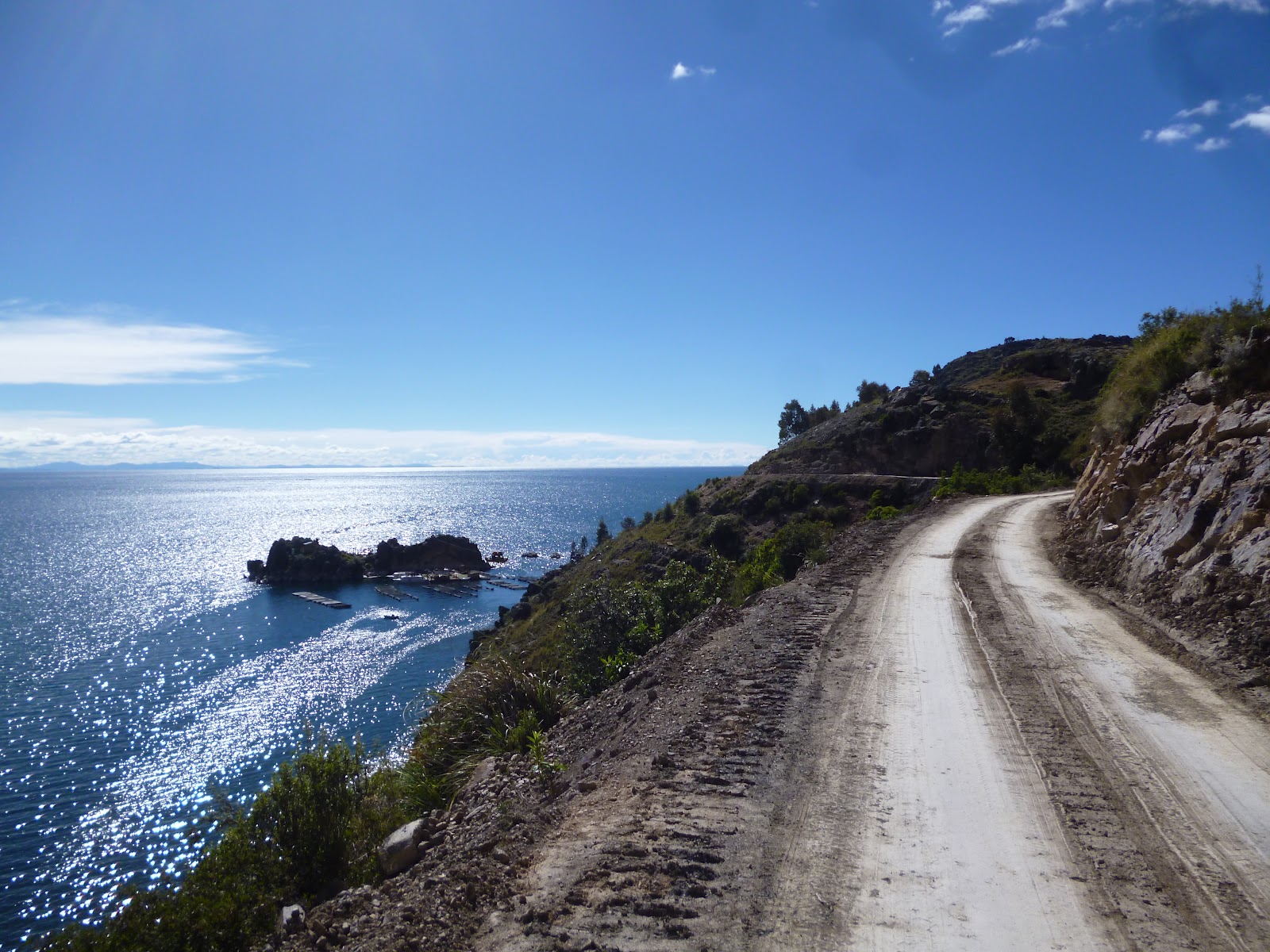
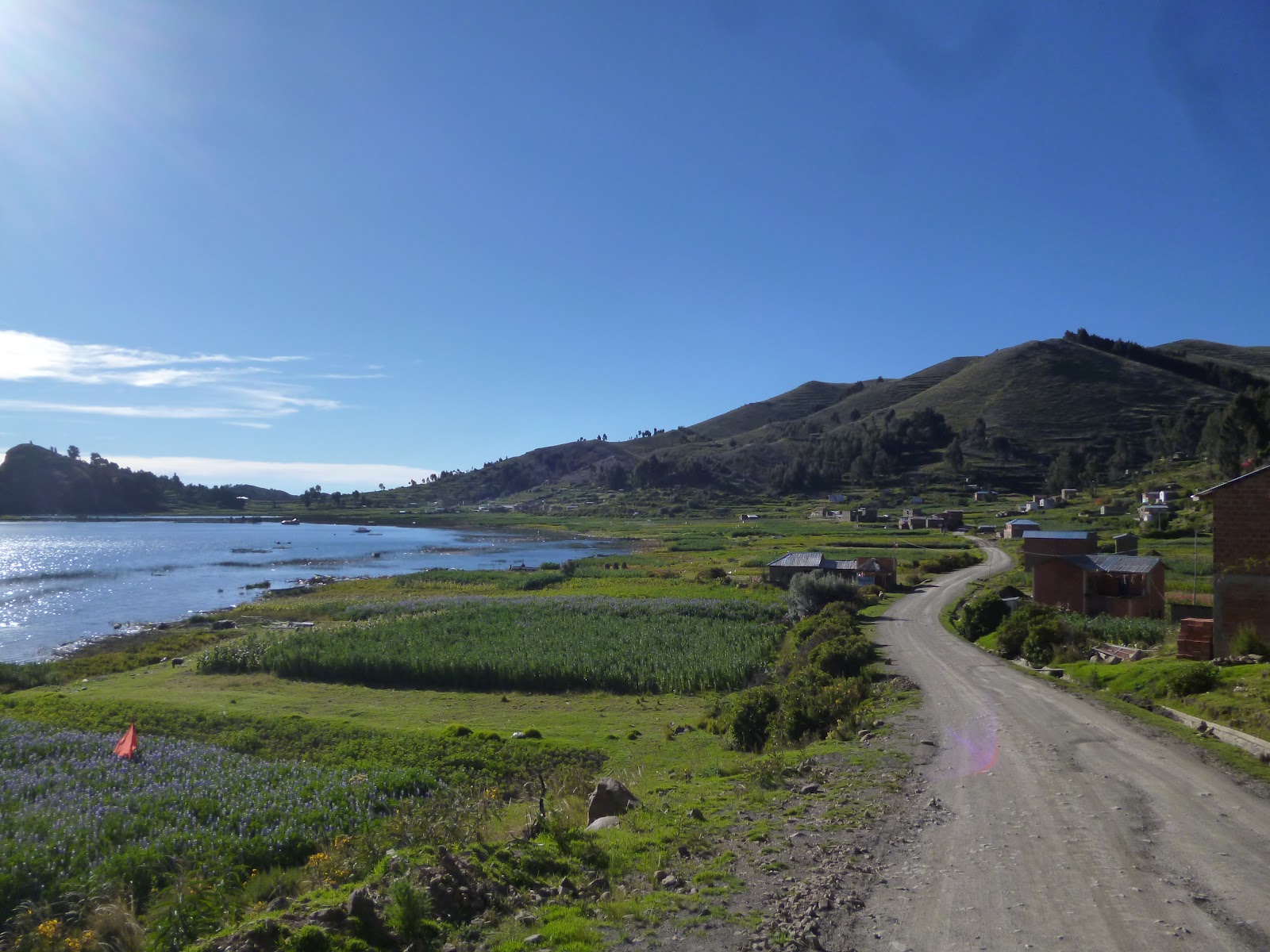
Another thing I hadn't done for a while was any exercise so after lunch I set off on a meaty 4-hour hike along the lakeside using some sketchy instructions from my lonely planet guide. The scenery was spectacular and the sense of adventure was augmented by mild assaults from territorial dogs and the odd rally car speeding along the dirt road along which I was walking (turns out they were practising for a race tomorrow). Lake Titikaka is huge to the point where the opposite bank is invisible to the naked eye and the bank to the east was framed by snow capped mountains in the distance - it felt more like walking next to a sea than any “lake” I'd ever been to.
As dusk approached I still hadn't reached my final destination and, although the occasional minibus had passed me, the lonely planet guide suggested getting a lift back to Copacabana might prove difficult. Despite this I persevered, convinced that if the worst came to the worst I would retrace my steps. My weary legs weren't so sure. Finally arriving at my destination, the village of Yampupata, I was overjoyed to see a minivan still parked by the harbour and the driver said he'd give me a lift back for a quid. I was less overjoyed when I saw that I would be sharing the journey with what must have been several hundred kilograms worth of freshly caught fish.

Having stuffed the minibus full, we set off and it quickly became apparent that our driver was in a hurry. Setting a pace not dissimilar to the rally cars I'd seen earlier, we quickly caught up and overtook several 4x4's I'd seen leave the village 5 minutes ahead of us. As we sped along the winding road, lined with more than the odd sheer drop, I envisaged headlines in the South Manchester Reporter in the event that this journey should be my last (they all revolved around sleeping with the fishes). On the other hand I reflected that this ride was far more exhilarating than many roller-coasters I'd been on. Probably because the potential for death was a bit more real.
Back in Copacabana I had trouble finding food that wasn't pizza or burgers but eventually stumbled upon the still-open market where old women cooking in the open air could be relied upon to provide cheap greasy fare. Copacabana is another town where the monster of tourism has begun to devour everything in its path and I didn't feel compelled to spend any more time here than I had to.

19/2/2012 - 9/3/2012 - Still in Arequipa, where the hell did the time go?

Looking back I can't really explain why I stayed in Arequipa for so long. It was probably a combination of travel fatigue and freaking out about the fast approaching end of my trip (and associated return to “real life”) which prompted me to start thinking about the future and looking for jobs back in the UK. I moved out of the relatively expensive Irish party hostel I'd been staying at into a more chilled out local run place. My recollection of the 2 weeks is a little hazy but involved a lot of time in the local library job hunting on the internet, cheap Chinese-Peruvian food (called Chifa) and a bit of sightseeing around Arequipa. 

Typical plate of tasty chifa
    Although in some ways reminiscent of a European city (attractive colonial-era architecture was ever-present, as were the McDonald's and Starbucks jostling for space with the local restaurants), Arequipa still held a lot of Peruvian quirks. One of the most striking was the clustering of shops which sold exactly the same thing and resulted in particular streets around the city being lined exclusively with, for example, opticians or suit makers etc. Apparently this is useful for shopping around and haggling the pants off competing shopkeepers. Makes sense I guess. Probably makes price fixing easier too.


I frequented the library in Arequipa so often that I became friendly with the receptionists to the point where one of them even invited me to her friend's wedding which I sadly couldn't attend since I'd forgotten to bring my suit to South America. The library also contained some private study rooms for which I was competing with a bunch of, believe it or not, physicists.
I'd walk into the rooms in the morning to find a garbled mess of maths and graphs which my brain assured me I'd known the meaning of once upon a time but which now looked like utter gibberish. Seeing the physicists sweating away at horrible looking equations late into the night really took me back to last year. Did I detect a faint urge within myself to go back to it all...?

At some point, the fear of not having a job when I got home was overpowered by the fear that I wouldn't actually make it to Buenos Aires in time for my flight home if I didn't start travelling again. And so on Friday the 9th of March I finally packed my bags, waved goodbye to the hostel owners with whom I'd shared a frequent rum and jumped in a cab headed to the bus terminal.
The chatty cab driver further put me in a travelling mood and, as we saw a wild eyed man in a torn shirt running away from a woman who looked like she was in the process of beating the crap out of him, I decided this was the right time to leave.

A relatively short bus journey saw me travel east and end up at Puno, a town near the Bolivian border, where I was rewarded with a glimpse of Lake Titikaka. Puno was a little touristy but it was nice to be exploring new places again. For dinner I found a cheap little place, asked for a typical dish and received fried sausage with spaghetti and chips. This was not my first, and certainly wouldn't be my last, encounter with “double-carbohydrates” which is omnipresent in Peru and goes some way to explaining people's podginess. Although I would be crossing into Bolivia tomorrow I'd been told the food there was more of the same. Bring it on.